
ACA International's Annual Convention is the one week of the year when the entire accounts receivable industry stands in the same room. Agency owners, VPs of collections, compliance directors, debt buyers, and the vendors trying to win their attention. This July, that room was in Orlando, with 85+ exhibitors and 31+ educational sessions over three days.
DROS was there at Booth #403. We ran live demos, gave away 2,000 free AI calling minutes to teams that signed up on the floor, and had hundreds of conversations with the people who run collections operations every day.
We went in with a thesis: voice AI solved the call, but nobody has solved the workflow around it. We came back with that thesis stress-tested against three days of unfiltered feedback. Here is what the industry actually told us.
1. Inbound is louder than the industry conversation suggests
Inbound was part of our booth story going in, and the floor confirmed it harder than we expected. While most of the industry conversation still revolves around outbound campaigns, dialer volumes, and contact rates, the question we heard over and over was a different one: can AI answer our phones?
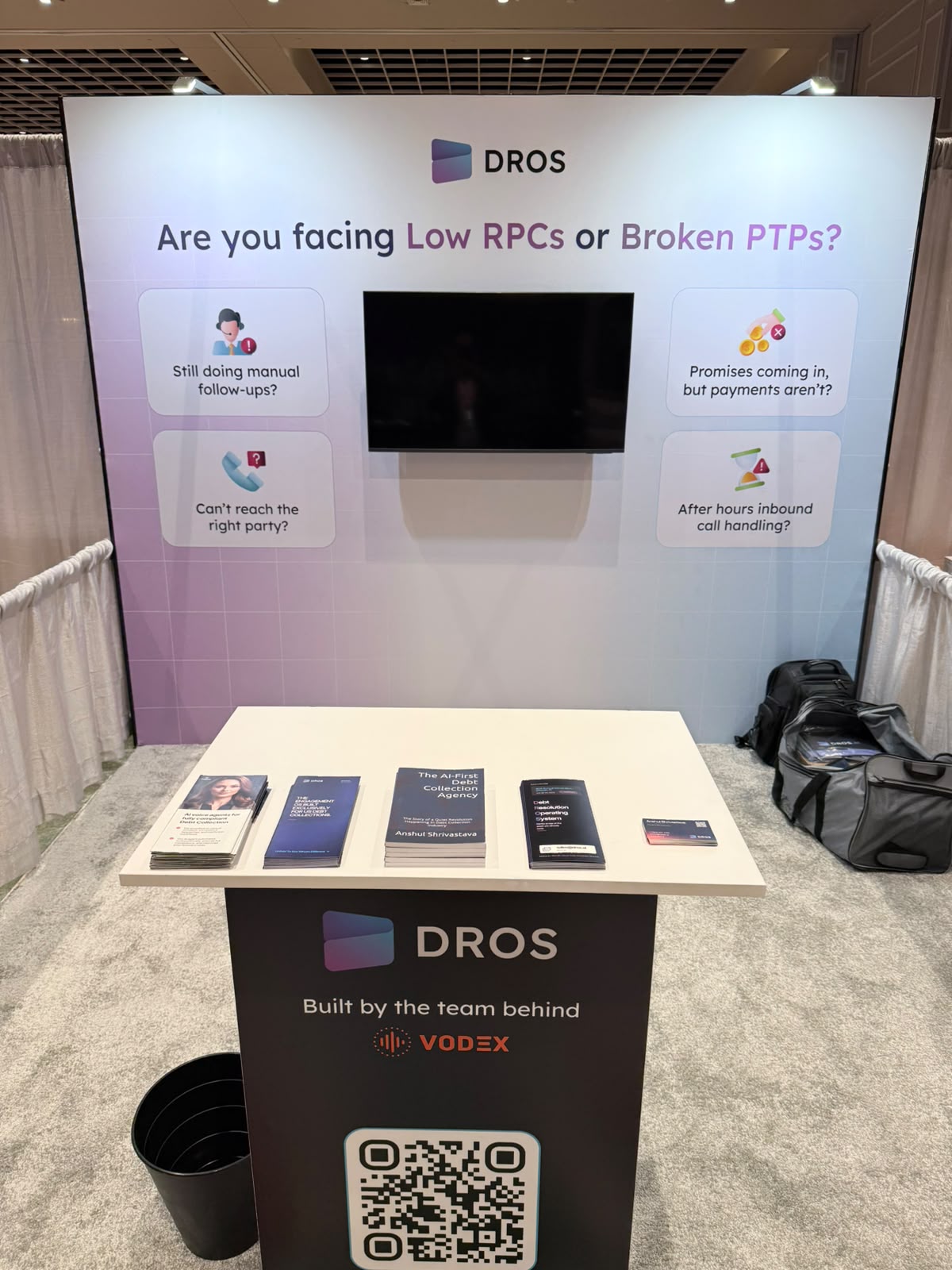
Booth #403. Inbound and after-hours handling was on our wall before the show opened. The floor confirmed it.
Operations leaders described inbound volumes in the tens of thousands of calls per month, after-hours coverage gaps, and consumers who call in ready to resolve an account but hit a queue instead. For many teams, the pain is not reaching people. It is being reachable.
What we heard
The first question at the booth was rarely "can your AI dial?" It was "can your AI pick up?" Inbound and after-hours coverage came up in more conversations than any outbound use case.
This matters because inbound is where intent lives. A consumer who calls in has already decided to engage. The operational question is whether your system can capture that moment with full account context, at any hour, on any channel.
2. Compliance is the opening question, not the closing one
Nobody at ACA asks about compliance as a checkbox at the end of a demo. It is the first thing out of their mouth. TCPA consent, revocation handling, validation notices, Reg F call frequency. The convention agenda reflected the same priority, with dedicated sessions on revocation protocols, FDCPA litigation trends, and CFPB and FCC policy.
The teams we spoke with were not asking whether AI can make calls. They were asking whether AI can prove that every call it made was allowed. Audit trails, centralized contact rules, and consent records came up constantly.
What we heard
Collections leaders have stopped evaluating AI on capability. They are evaluating it on defensibility. "Show me the audit trail" has replaced "show me the demo."
3. Consumers may prefer telling AI about their debt
The most counterintuitive insight of the week, and one we heard from multiple corners of the floor: many consumers seem more comfortable discussing their debt with an AI agent than with a human collector.
The reason is simple once you hear it. Debt carries shame. Explaining a missed payment to another person is uncomfortable in a way that explaining it to a system is not. No judgment, no embarrassment, no pressure to save face.
"People will tell a machine things they will not tell a person. In collections, that honesty is the whole game."
For an industry built on difficult conversations, this reframes AI from a cost-saving tool into something closer to a consumer preference. That is a very different adoption story than the one most vendors are telling.
4. The digital shift is further along than assumed
One operations team told us their digital validation notices, delivered by text and email, were performing better than expected. Not as a compliance workaround, but as a channel consumers actually respond to.
Combined with the convention's session focus on digital-first collections strategies and consumer communication preferences, the signal is clear. The industry's digital transition is not coming. It is already here, and the teams treating text, email, and self-serve as first-class channels are pulling ahead of the ones still treating them as fallbacks.
5. AI is settled. Orchestration is not.
Walk the expo floor and you would struggle to find a vendor without AI in their pitch. The debate over whether AI belongs in collections is over. What is unsettled, and what came through in almost every serious conversation we had, is how to run it responsibly at scale.
Teams have voice AI. They have SMS platforms. They have dialers and CRMs. What they do not have is one system where all of it shares the same context, follows the same rules, and reports into the same timeline. One bot ignores what another bot did this morning. Call-hour rules live in three different tools. Nobody can show a client a clean picture of what happened on a single account.
What we heard
The gap in the market is not another bot. It is the layer that makes all the bots, channels, and human teams behave like one system.
What this means for what we build
We came to Orlando to talk about DROS as the operating layer for collections engagement. We left more convinced of the framing than when we arrived, with two additions to how we think about it.
- First, inbound deserves the same orchestration rigor as outbound. Answering a consumer-initiated call with full account context, at 2 a.m., in a compliant flow, is exactly the kind of problem an operating layer exists to solve.
- Second, the compliance conversation is now the buying conversation. Centralized contact rules, enforced before any touchpoint fires, with a traceable record of every decision, is not a feature. It is the price of entry.
Voice solved the call. It never solved the workflow. Three days in Orlando confirmed the industry knows it too.
Met us at Booth #403? Missed us entirely?
Either way, the conversation is open. See how DROS connects voice, SMS, email, and self-serve into one compliant engagement layer, with every touchpoint sharing the same context.